



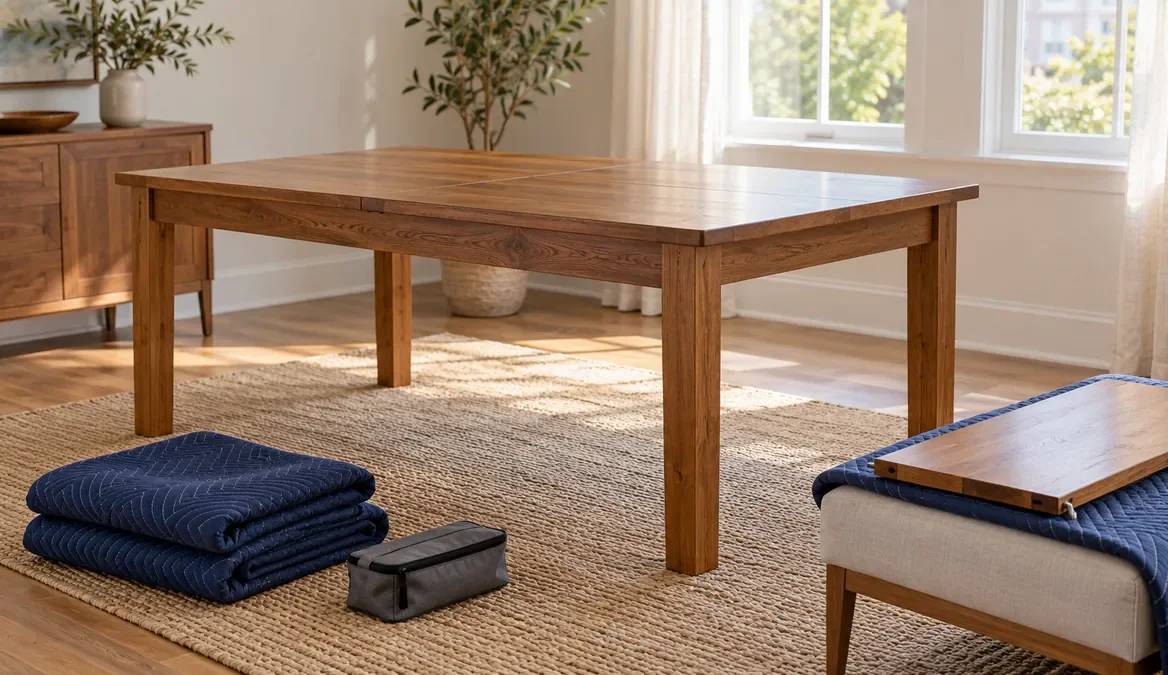
How to Move a Dining Table: Tops, Leaves and Hardware
Before moving a dining table, identify what it is made of and how it is assembled. A solid-wood table, a veneered extension table and a stone top on a separate base need different preparation. Confirm the route, the manufacturer's instructions and who will dismantle and reassemble the piece before the crew arrives.
Identify the table, not just its outside dimensions
Find the maker, model and assembly instructions. Photograph the whole table, underside, leg connections, extension mechanism and any existing marks. Record the dimensions in its normal and extended states, plus those of each component that can actually be removed under the instructions.
If the table is a second-hand purchase, ask the seller for the manual, loose leaves, brackets, fasteners and any stored packaging. Do not assume a top lifts off because a similar-looking model does. Some tops are attached, some rest on pads and others have mechanisms or bonded components that need specialist assessment.
| Table type | What to confirm |
|---|---|
| Wood or veneer | Approved lifting points, finish-safe protection and whether legs or leaves are designed for removal. |
| Extension table | Leaf type, lock or latch procedure, rail protection and how loose leaves travel. |
| Glass top | Attachment method, existing edge damage, suitable protective support and qualified handling. |
| Stone or marble | Actual weight, top-to-base connection and the maker's transport orientation and support requirements. |
| Unknown or repaired piece | Material, hidden repairs and a suitable assessment before dismantling or lifting. |
Use the right instructions for wood, glass and stone
Wood and extension mechanisms: the Willis & Gambier Antoinette care guide advises against dragging and identifies the apron, rather than the tabletop, as its dining-table lifting point to protect the extension mechanism. That is useful evidence that lifting points matter, not a substitute for your own model's instructions. Have the handling team identify the correct structural support before moving it.
Glass: inspect edges and surfaces before wrapping. IKEA's tempered-glass instructions warn that damaged edges or scratched surfaces can lead to sudden cracking, and caution against direct contact with hard surfaces. If you find damage, stop and ask the manufacturer or a qualified glass professional how to proceed. A blanket does not repair a chipped edge or make an uncertain top safe.
Stone: obtain model-specific instructions and a suitable handling plan. Rowico Home's marble and travertine guidance specifies vertical carrying for its tops. Do not generalize that into a DIY instruction for every slab: the connection, dimensions, support equipment and competent crew still need assessment. Tell the provider about the material and weight before booking rather than describing it only as a dining table.
Keep leaves, fittings and hardware together
Remove a loose leaf only as the maker permits. A self-storing or butterfly leaf is a mechanism, not necessarily a removable panel. Photograph its normal position and any locking arrangement. Do not force a stiff rail, remove a structural bracket experimentally or tighten a fitting to compensate for an unexplained wobble.
- Photograph each permitted connection before separation.
- Assign matching identifiers to components using removable labels on protective packaging, not adhesive on the finish.
- Bag bolts, washers and brackets by connection; record the count and any missing parts.
- Pack removable leaves separately with suitable clean cushioning and supported edges.
- Keep the instructions and hardware in a named, reachable container and tell the receiver who has it.
Do not tape a hardware bag directly to polished wood or glass. Keep hard loose fasteners from rubbing against finished surfaces. If parts are missing, identify the correct replacements through the manufacturer rather than improvising before the table is put back into use.
Measure the protected components against the whole route
Check door openings, hallway turns, stairs, lift doors and the lift cabin at both addresses. Include the thickness of protective packaging. An extended tabletop dimension is different from the length of the component that will actually travel, but dismantling does not automatically solve a tight turn.
Send the provider photographs of uncertain access and the measured components. Ask for an assessment where needed. Do not start removing building doors, using balconies or forcing a top through a turn without the appropriate agreement and qualified handling. The sofa access guide explains the wider route checks.
Agree the service and check the table at delivery
Ask separately about preparation, dismantling, transport protection, reassembly and removal of packing. Do not assume an ordinary moving booking includes every task. Provide the material, weight, components and access details so the provider can confirm acceptance and the actual scope.
At delivery, compare the components with your list before discarding protection. Have assembly completed to the manufacturer's instructions, check required fittings and stability, and resolve any fault before use. Keep clear photographs and report damage promptly through the provider's procedure. For the rest of the home, use the preparation guide; for a standalone collection, see single-item moving.
Frequently asked questions
Should I remove the legs from every dining table?
No. Check whether the model is designed for it and arrange competent dismantling and reassembly. Some connections or repairs need a different plan.
Can a glass or stone top be booked as an ordinary table?
Describe its material, dimensions, weight and attachment method first. Ask the provider to confirm acceptance, suitable protection and the handling plan.
Where should table hardware travel?
Use clearly identified bags grouped by connection, inside a named reachable container. Keep them away from finished surfaces and tell the receiver who holds them.
Sources
Researched 2026-10-24. Check the linked source for later changes.